



•
Citation
Kyumin Kim, Dohae Lee, Hanul Baek, and In-Kwon Lee, “RotGS: Rotation-Guided 3D Gaussian Splatting for Turntable Sequences without Structure-from-Motion”, Computer Graphics Forum (to appear), also presented at Eurographics 2026.
•
Abstract
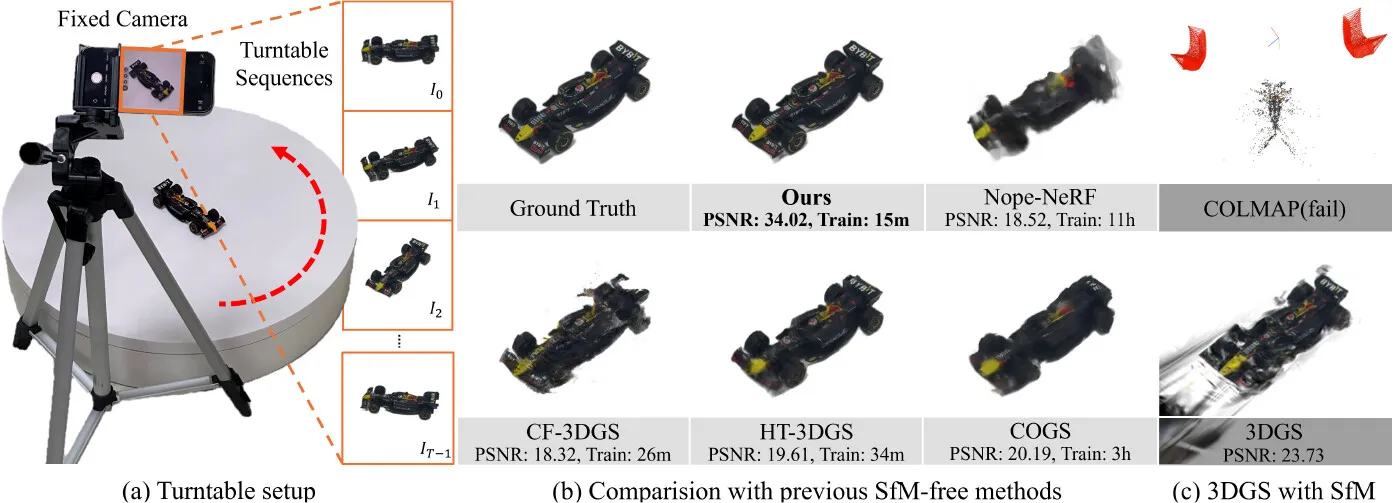
The field of 3D reconstruction from multi-view images has advanced rapidly thanks to 3D Gaussian Splatting (3DGS), which enables efficient and photorealistic scene representation. However, optimizing 3DGS requires high-quality images from various viewpoints with accurate camera poses. The repeated collection of such data demands significant human effort, which poses a major constraint in practical applications. To address this issue, automated capturing systems that uses a turntable and fixed camera are widely employed. In a turntable setup, the background remains stationary while the object rotates. Therefore, preprocessing to remove the backgrond is essential, but the preprocessing reduces the number of reliable feature matches, which destabilizes Structure-from-Motion (SfM). This results in inaccurate camera poses, which degrades the quality of 3DGS reconstruction. We propose a novel method to optimize 3DGS in a turntable setup without SfM by leveraging the prior knowledge that objects rotate around a central axis. Unlike previous SfM-free methods that estimate camera poses for each frame, our approach reduces the complexity of optimization by representing rotations with a single global rotation axis. The estimated rotation is directly applied to the 3D Gaussians, producing motion defined as rotation flow. This rotation flow is then aligned with optical flow to provide strong geometric supervision. Through uncertainty-to-detail flow scheduling, our approach remains stable during the initial training stage when the geometry of the Gaussian set is still inaccurate. On the NeRF-Synthetic dataset and on real-world datasets captured with a turntable, our method outperforms existing SfM-free approaches in both reconstruction quality and training speed, and even demonstrates performance comparable to 3DGS optimized with precise camera poses.
