



•
Citation
◦
Hayeon Kim and In-Kwon Lee, “From Asymmetric Guidance to Shared Evidence: Governing the Visibility of Spatial Cues in Multi-User Virtual Reality,” IEEE Transactions on Visualization and Computer Graphics, accepted, also will be presented in IEEE ISMAR 2026.
•
Abstract
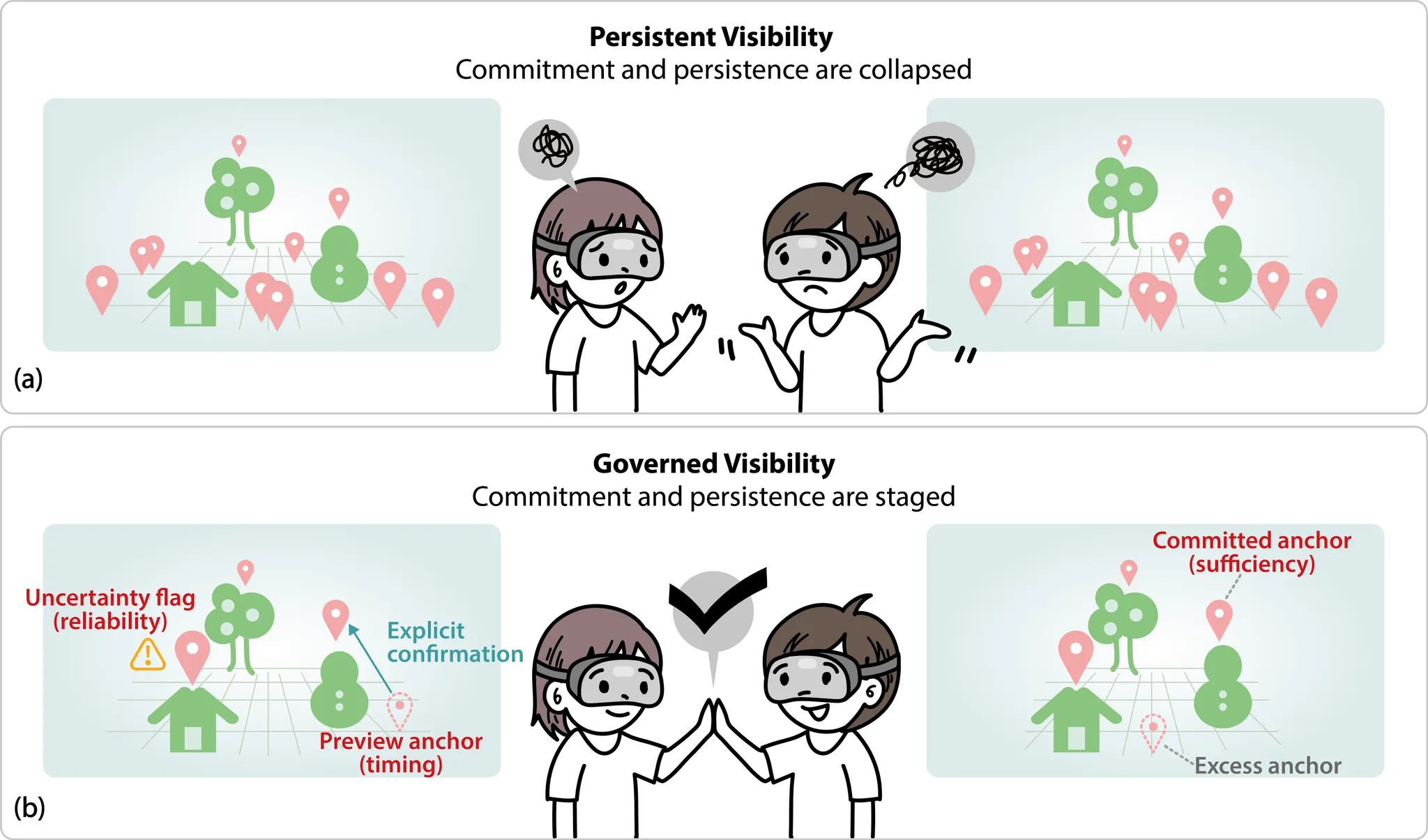
In multi-user virtual reality (VR), collaborators increasingly rely on private, uncertain guidance, such as AI-generated overlays visible to only one of them. Acting jointly requires turning this guidance into shared spatial evidence, typically externalized as user-placed anchors. Under the prevailing default of persistent visibility, anchors persist once created: commitment collapses into persistence, outdated anchors accumulate, and uncertain guidance invites uncritical acceptance. We propose a governed visibility policy that stages the transition from proposal to persistence as a lifecycle: anchors are proposed through transient previews, qualified by propagated uncertainty, committed through explicit confirmation, and retained under bounded persistence. Each mechanism is familiar; the contribution lies in ordering them as stages of a single lifecycle. In a dyadic navigation testbed (three studies, 230 participants), a confirmatory comparison shows that the governed policy accelerates alignment, reduces the acceptance of incorrect proposals without a detectable cost to the acceptance of correct ones, and keeps committed anchors closer to the number each scene requires; underspecification remains rare under both policies. These findings recast visibility not as a display property to maximize, but as a coordination policy to design.
•
Files