

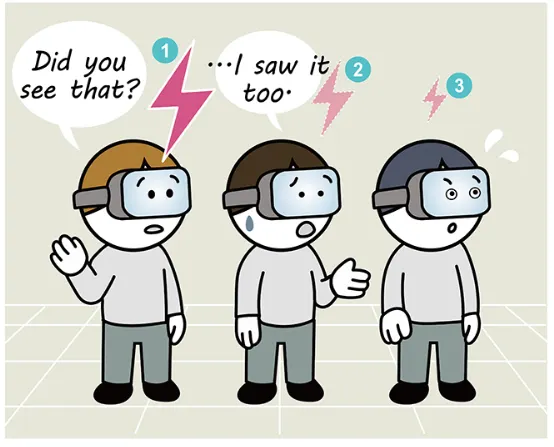
Prof. Hayeon Kim (Dankook Univ) and Prof. In-Kwon Lee has announced that their paper, "Disruption Timing as Information Structure: Collective Recovery in Multi-User Virtual Reality," has been accepted at CHI 2026, the world's premier conference for Human-Computer Interaction (HCI).
In collaborative VR environments, developers often strive for "seamlessness," attempting to hide technical glitches. However, this study uncovers a paradox: concealing failures creates asymmetric awareness among users, which can fracture the shared reality necessary for effective teamwork.
The researchers propose a paradigm shift, treating disruption timing as a deliberate "information structure." Using the theory of Rational Rituals, they introduced the Public, Synchronous, Bounded (PSB) anchor. This design strategy ensures that when a system failure occurs, it happens simultaneously for all users, establishing the "common knowledge" needed for a collective response.
The study, involving 102 participants, demonstrates that fostering a "shared struggle" can be more beneficial for group coordination than maintaining a fragile, individual illusion of seamlessness.
The work will be presented at CHI 2026 in Barcelona, Spain, where experts in XR, UI/UX, and social computing gather to discuss the future of human-technology interaction.