



A research team led by Professor In-Kwon Lee at Yonsei University has achieved a remarkable double-header at IEEE VR 2026, the premier international conference for virtual reality. Both papers have been selected for simultaneous publication in the prestigious journal IEEE Transactions on Visualization and Computer Graphics (TVCG).
Study 1: Defining the "Comfort Envelope" for VR Distortions
In the paper "How Much Is Too Much?", Professor Hayeon Kim (Dankook Univ.) and Professor Lee investigate the limits of visual-motor distortions. While VR allows for stretched limbs and rescaled motions, exceeding certain limits breaks the user’s sense of agency and presence. The team introduced the Comfort Envelope, a multi-dimensional budget that guides designers on how much distortion a user can tolerate before the experience collapses. Their study with 52 participants revealed that predictable distortions increase tolerance by 35%, providing a reproducible protocol for future VR interface design.
Study 2: Seamless Walking via Non-Euclidean Portal Resets
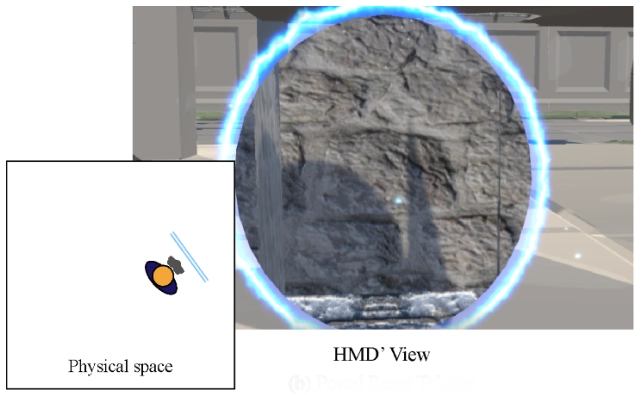
The second paper, led by Ho Jung Lee and his colleagues, introduces NEPR (Non-Euclidean Portal Reset), a breakthrough in Redirected Walking (RDW). Traditionally, when a user reaches a physical wall, they must stop and "turn-in-place," breaking immersion. NEPR eliminates this interruption by opening a virtual portal to a non-Euclidean corridor. As the user walks through this short corridor, their physical position is subtly reset without them ever needing to stop. This "continuous walking" approach significantly outperforms traditional resets in both user experience and task efficiency.
These works will be presented at IEEE VR 2026 in Daegu, Korea. By balancing technical innovation with human perception, Professor Lee’s team continues to redefine the boundaries of what is possible in immersive environments.