
가상현실(VR) 상호작용 분야의 핵심 미해결 문제—얼마나 왜곡해야 너무 많은 것인가?—에 정면으로 답한 국내 연구가 세계 최고 권위의 VR 학술대회에서 최우수 논문으로 선정됐다.
단국대학교 소프트웨어학과 김하연 교수와 연세대학교 컴퓨터과학과 이인권 교수가 공동 저술한 논문 "How Much Is Too Much? Comfort Envelopes for Distortions in Virtual Reality Interaction"이 오는 3월 21일부터 25일까지 대구 EXCO에서 개최되는 IEEE VR 2026 (IEEE Conference on Virtual Reality and 3D User Interfaces)에서 Best Paper로 선정됐다.
IEEE VR은 가상현실·증강현실·3D 사용자 인터페이스 분야를 대표하는 국제 학술대회로, IEEE Computer Society 및 Visualization and Graphics Technical Committee(VGTC)가 주관한다. 매년 전 세계에서 수백 편의 논문이 제출되며, 그 가운데 엄격한 심사를 통과한 소수의 연구만이 Best Paper로 인정받는다. 올해 대회가 대한민국 대구에서 개최된다는 점에서 국내 연구진의 수상은 더욱 각별한 의미를 갖는다.
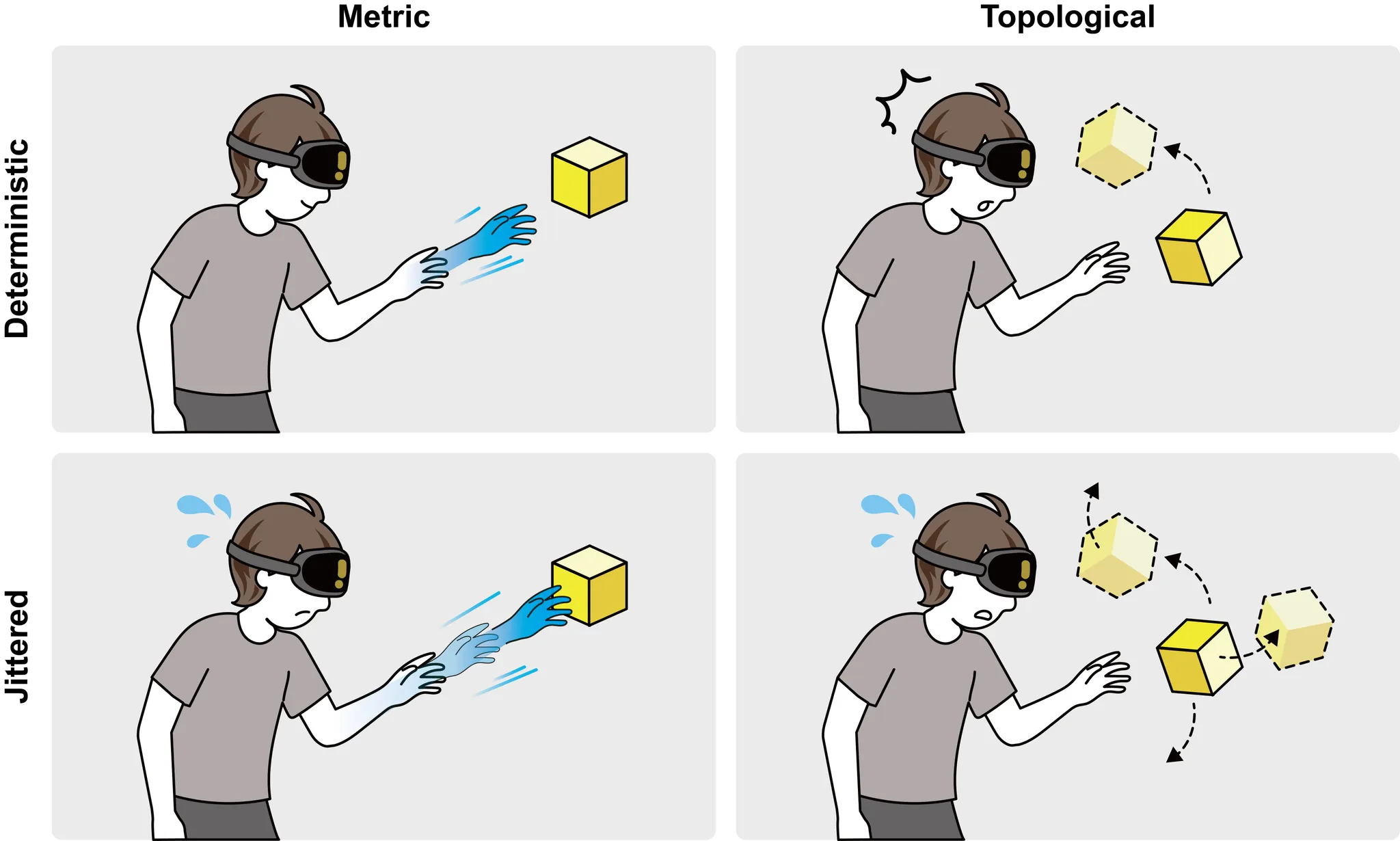
이 논문은 VR에서 필연적으로 발생하는 다양한 공간 왜곡—손의 움직임 배율 조정, 순간이동, 시점 재배치 등—이 사용자의 현존감(Presence)과 행위 주체감(Agency)에 미치는 영향을 통합적으로 분석한 연구다. 연구팀은 왜곡을 연속적 메트릭 편차(metric deviations)와 불연속적 위상 단절(topological breaks)의 두 축으로 분류하는 SIDA(Single-Interaction Dual-Axis) 프레임워크를 제안하고, N=52명 참가자를 대상으로 한 정신물리학 실험을 통해 사용자가 각 왜곡 유형을 수용 가능한 한계치, 즉 쾌적 포락선(Comfort Envelope)을 정량화했다. 연구의 핵심 발견은 세 가지다: 연속적 왜곡은 비연속적 왜곡보다 훨씬 높은 관용도를 가지며, 예측 가능한 매핑은 허용 범위를 약 35% 확장시키고, 두 종류의 왜곡은 서로 경쟁하는 방식으로 결합되어 허용 예산을 비선형적으로 제한한다는 것이다. 이 연구는 VR 디자이너들이 그동안 시행착오에 의존해 온 상호작용 왜곡의 허용 한계를 처음으로 원칙적이고 정량적인 방식으로 제시했다는 점에서 의의가 있다.
A joint research team from Dankook University and Yonsei University has won the Best Paper award at IEEE VR 2026 (IEEE Conference on Virtual Reality and 3D User Interfaces), to be held March 21–25 at EXCO in Daegu, Republic of Korea.
The awarded paper, "How Much Is Too Much? Comfort Envelopes for Distortions in Virtual Reality Interaction", was co-authored by Prof. Hayeon Kim (Department of Software Science, Dankook University) and Prof. In-Kwon Lee (Department of Computer Science, Yonsei University).
IEEE VR is the world's foremost academic venue dedicated to virtual reality, augmented reality, and 3D user interfaces, sponsored by the IEEE Computer Society and the IEEE Visualization and Graphics Technical Committee (VGTC). Each year, hundreds of submissions undergo rigorous peer review, and only a small number of exceptional contributions are recognized with the Best Paper distinction. The honor carries additional significance this year as the conference is held in Korea for the first time.
The paper addresses a long-standing, open challenge in VR design: how far can spatial distortions—such as reach scaling, teleportation, or object relocation—be pushed before they destroy the user's sense of presence or agency? The team introduces the Single-Interaction Dual-Axis (SIDA) framework, which classifies distortions into two principled categories: metric deviations (continuous, topology-preserving remappings) and topological breaks (discontinuous, state-replacing jumps). Through a psychophysical study with N=52 participants, they quantify the Comfort Envelope—a multi-dimensional map of acceptable distortion thresholds. Three core findings emerge: continuous distortions are substantially more tolerable than discrete ones; predictable mappings expand the tolerance budget by approximately 35%; and when both types of distortion are applied simultaneously, they compete for a shared cognitive resource, producing a contractive, non-additive budget. The findings translate directly into actionable design guidelines, enabling VR developers to move beyond trial-and-error and embed psychophysically grounded limits into the interaction design process.
